Auction House Cars: Do You Still Need a PPSR Check?
Buying a car at auction can feel safer than a private sale because there is a business standing behind the transaction, complete with a catalogue, a gavel and sometimes even a warranty. That impression can be misleading, however, when it comes to registered finance and other security interests recorded against the vehicle. Auction houses sell cars on behalf of banks, fleet companies, insurers and private consignors, and in most cases they are not required to guarantee the car is free of finance. A Personal Property Securities Register check remains just as important at an auction as it is when buying from a driveway or a classified listing.
Why People Assume Auction Cars Are Already “Checked”
There is a common belief that vehicles reaching the auction floor have already been vetted, especially when they come from bank repossessions, government fleets or dealer trade-ins. In reality, the auction house’s role is usually limited to facilitating the sale and verifying basic identity and registration details, not clearing outstanding finance. Repossessed vehicles in particular can still carry a registered interest if the paperwork between the financier and the auction house has not been finalised, and fleet or lease vehicles are sometimes sold before the underlying finance arrangement has been fully settled.
What Auction Houses Actually Guarantee
Most auction conditions of sale explicitly state that vehicles are sold as is, where is, with no warranty as to condition, and often with limited or no warranty regarding encumbrances. Some larger auction groups do run their own background checks and disclose known issues in the catalogue, but the terms and conditions almost always place the final responsibility for due diligence on the buyer. Reading the fine print before you bid is essential, since it will tell you exactly what protection, if any, you are entitled to if a problem surfaces after the sale.
Types of Vehicle Auctions and the Risk Profile of Each
Not all auctions carry the same level of risk. Bank and finance company repossession auctions typically involve vehicles where the original finance is being cleared as part of the sale process, which usually reduces risk, though delays in paperwork can still leave a stale registration on the register. Government and corporate fleet auctions tend to be lower risk since vehicles are usually owned outright. Salvage and insurance auctions carry a different kind of risk centred on written-off status rather than finance. Public and online auctions that aggregate vehicles from private consignors carry the widest range of risk, since sellers can list a car with existing finance without the auction house necessarily verifying this in advance.
How to Run Your Own PPSR Check on an Auction Vehicle
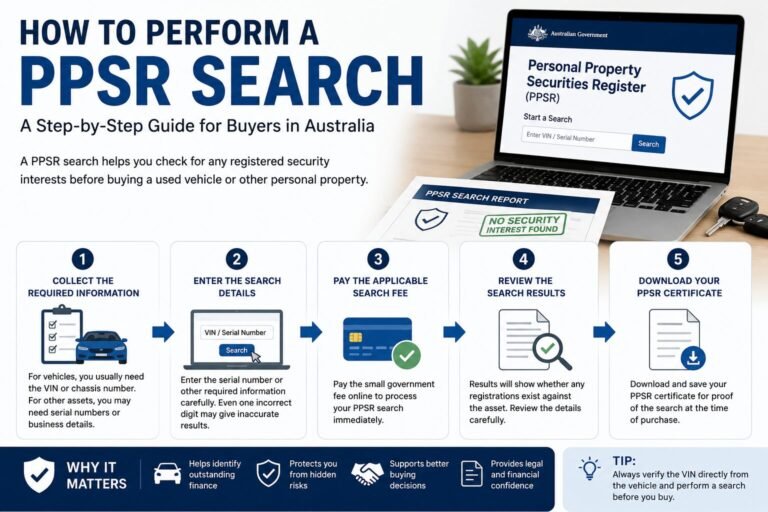
Before you register to bid, note down the VIN listed in the auction catalogue and run an independent search rather than relying solely on any disclosure provided by the auction house. Compare the registered owner and any secured party details against what the auction listing tells you about the vehicle’s history. If the auction is happening quickly, try to complete this search as close to the auction date as possible, since a certificate generated weeks earlier may not reflect finance taken out or discharged in the meantime. Keep a copy of your search results in case a dispute arises after settlement.
Reading the Auction Catalogue Alongside the PPSR Certificate
A thorough approach combines the auction catalogue’s disclosures with your own PPSR certificate. Look for any mention of the vehicle being sold subject to finance clearance, and cross check the odometer reading and written-off status disclosed in the catalogue against the PPSR result and other vehicle history checks. If the catalogue is silent on finance but your search reveals an active security interest, raise this with the auction house before bidding, since some auctions will clear the interest prior to sale while others will pass the vehicle to you encumbered.
What If You Find an Issue After the Hammer Falls
If you discover a registered security interest after winning the bid, contact the auction house immediately, as most have a dispute process for exactly this situation and may be obligated under consumer law to resolve undisclosed finance issues. Keep all documentation, including your PPSR certificate dated before the sale, the auction catalogue entry and your payment receipt, since this evidence will support any claim. Acting quickly gives you the best chance of a favourable outcome before the vehicle is transferred or the auction house’s dispute window closes.
Auction houses can offer a convenient way to buy a used car, but the hammer coming down does not erase existing finance or legal claims against the vehicle. Running a PPSR check before you bid takes only a few minutes and gives you the same protection you would seek in any other used car purchase, letting you bid with confidence rather than hope.