
What Is PPSR? The Ultimate Guide to Australia’s Personal Property Securities Register
If you’re buying a used car, motorcycle, boat, caravan, or business equipment in Australia, performing a PPSR check is one of the smartest steps you can take before completing the purchase. A quick search can reveal whether an asset has money owing, is recorded as stolen, or has a registered security interest that could affect your ownership rights.
Many buyers only discover the importance of the Personal Property Securities Register (PPSR) after purchasing a vehicle with outstanding finance or becoming involved in an ownership dispute. Spending a few minutes understanding how PPSR works can help you avoid financial loss and make informed buying decisions.
This guide explains everything you need to know about PPSR, including what it is, how it works, why it matters, who uses it, what information it contains, and how to perform a PPSR search correctly.
Table of Contents
What Is PPSR?
PPSR stands for Personal Property Securities Register. It is Australia’s national online register that records security interests in personal property.
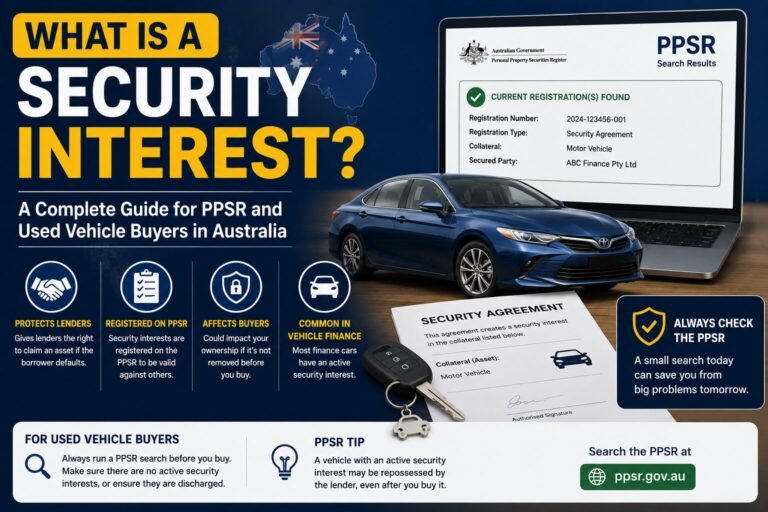
A security interest is a legal right over personal property that is usually created when an asset is used as collateral for a loan or finance agreement. If the borrower fails to meet the terms of the agreement, the lender or secured party may have the legal right to repossess or recover the asset.
The PPSR allows individuals and businesses to search for registered security interests before buying or financing personal property. It helps create transparency by allowing buyers to check whether an asset has existing financial obligations or other registered interests.
Unlike land and buildings, which are recorded through separate land title systems, the PPSR covers a wide range of personal property.
What Is Personal Property?
Under Australian law, personal property refers to almost any type of property other than land and buildings.
Examples include:
- Cars
- SUVs
- Motorcycles
- Trucks
- Vans
- Boats
- Jet skis
- Caravans
- Trailers
- Agricultural machinery
- Construction equipment
- Mining equipment
- Aircraft
- Livestock
- Business equipment
- Manufacturing machinery
- Inventory
- Intellectual property
- Accounts receivable
If any of these assets are used as security for finance or commercial transactions, a security interest may be registered on the PPSR.
Why Was PPSR Introduced?
Before the PPSR was introduced, Australia had numerous separate state and territory registers for recording security interests. Different systems applied to different types of assets, making it difficult for lenders, businesses, and buyers to determine whether personal property was already subject to finance or other legal claims.
To simplify this process, the Australian Government introduced the Personal Property Securities Act 2009 (PPSA) and launched the PPSR in 2012.
The register replaced many previous systems with one national database that provides consistent rules across Australia.
The objectives of the PPSR include:
- Improving transparency
- Reducing fraud
- Protecting buyers
- Simplifying lending practices
- Supporting commercial transactions
- Providing certainty for secured creditors
Today, the PPSR plays an important role in Australia’s financial and legal system.
How Does PPSR Work?
The PPSR works by allowing secured parties to register their legal interest in personal property.
Here’s a simple example.
Sarah purchases a new car using finance from a bank.
Although Sarah owns and drives the vehicle, the bank registers a security interest over the car because it financed the purchase.
If Sarah later attempts to sell the vehicle before repaying the loan, a PPSR search can reveal the registered security interest.
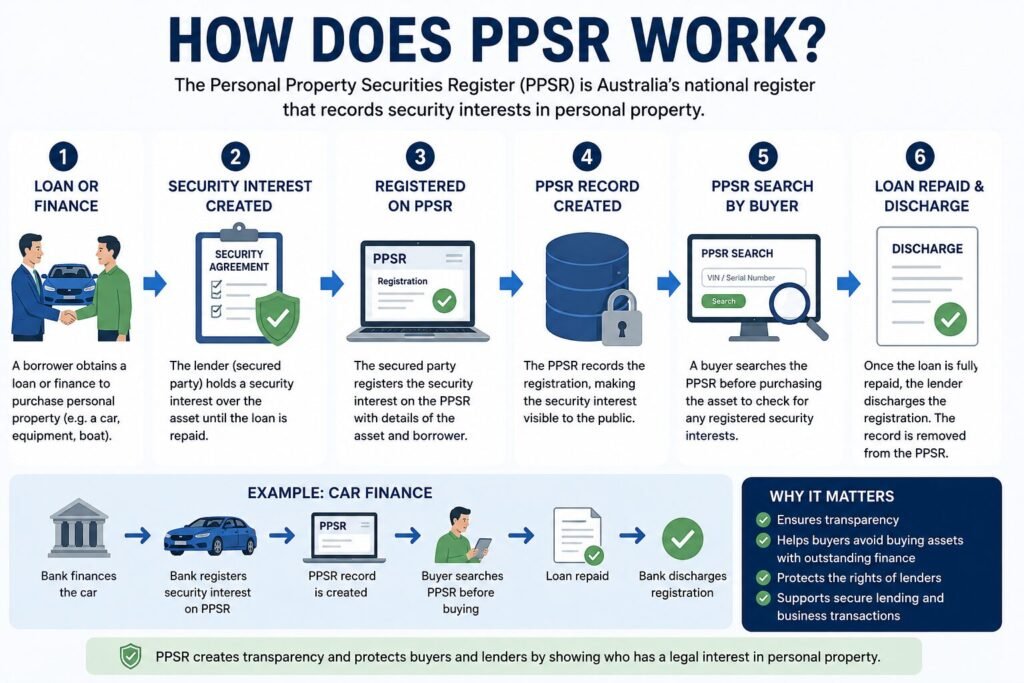
This allows potential buyers to identify financial obligations before completing the purchase.
Once the loan has been fully repaid, the lender can discharge the registration, removing the security interest from the register.
Understanding Security Interests
A security interest is a legal claim over personal property that secures payment or performance of an obligation.
Common examples include:
- Car loans
- Equipment finance
- Business loans
- Commercial leases
- Hire purchase agreements
- Floor plan financing
- Retention of title arrangements
- Inventory financing
Security interests protect lenders by giving them certain legal rights if a borrower defaults on their obligations.
Who Uses PPSR?
The PPSR is used by many different individuals and organisations across Australia.
Private Buyers
People purchasing used vehicles often perform a PPSR check to determine whether the vehicle has outstanding finance or other registered interests.
Vehicle Dealers
Dealers regularly search the PPSR before purchasing trade-in vehicles or selling used inventory.
Banks and Finance Companies
Financial institutions register security interests when providing loans secured against personal property.
Businesses
Businesses use PPSR registrations to protect valuable assets, inventory, equipment, and commercial transactions.
Lawyers and Accountants
Legal and financial professionals use the register during due diligence processes involving business purchases, insolvency matters, and commercial lending.
Insolvency Practitioners
Administrators and liquidators often search PPSR records when assessing business assets during insolvency proceedings.
Why Is PPSR Important?
Many buyers assume that if a seller possesses a vehicle, they have clear ownership and the right to sell it without restrictions.
Unfortunately, this is not always the case.
A vehicle may still have:
- Outstanding finance
- A registered security interest
- Leasing obligations
- Commercial encumbrances
Conducting a PPSR search before purchasing personal property helps reduce these risks.
For buyers, the register provides greater confidence that an asset does not have undisclosed financial obligations.
For lenders, PPSR registrations help establish legal priority over secured assets.
Benefits of Performing a PPSR Check
A PPSR search provides several important benefits.
Helps Identify Outstanding Finance
One of the main reasons people perform a PPSR check is to determine whether money is still owed on a vehicle or other asset.
Buying a financed vehicle without understanding its legal status can create unnecessary complications.
Supports Better Buying Decisions
A PPSR search provides useful information that helps buyers make informed purchasing decisions.
Rather than relying solely on information provided by the seller, buyers can verify whether registered security interests exist.
Protects Against Unexpected Claims
Registered security interests notify potential buyers that another party may have legal rights over the asset.
Understanding these registrations before purchasing reduces the likelihood of future ownership disputes.
Assists Businesses
Businesses use PPSR registrations to protect inventory, equipment, and commercial assets supplied on credit.
Proper registrations can improve legal protection in the event of customer insolvency or payment default.
What Information Can Be Found on PPSR?
Depending on the type of search performed, PPSR records may include information such as:
- Registration status
- Registration number
- Registration start date
- Expiry date
- Registration duration
- Collateral class
- Property description
- Vehicle Identification Number (VIN)
- Chassis number
- Engine number (where applicable)
- Secured party details
- Registration type
A PPSR certificate summarises the search results and records the information available at the time the search was conducted.
What Cannot Be Confirmed Through PPSR?
Although PPSR is an important source of information, it has limitations.
A PPSR search generally does not confirm:
- Legal ownership
- Vehicle condition
- Service history
- Mechanical problems
- Accident history
- Odometer accuracy
- Roadworthiness
- Registration status
- Insurance history
Buyers should combine a PPSR search with other inspections and checks before purchasing a used vehicle.
What Is a PPSR Certificate?
A PPSR certificate is an official record generated after completing a PPSR search.
It summarises the information available on the register at the time of the search.
A typical certificate includes:
- Search reference number
- Date and time of search
- Serial number searched
- Registration details
- Security interests found
- Collateral information
- Registration duration
- Search outcome
Many buyers keep a copy of the certificate as part of their purchase records.
When Should You Perform a PPSR Check?
A PPSR search is recommended whenever you intend to purchase personal property that may have financial obligations attached to it.
Common situations include:
- Buying a used car
- Buying a motorcycle
- Purchasing a caravan
- Buying a trailer
- Purchasing heavy machinery
- Buying farming equipment
- Purchasing construction equipment
- Acquiring business assets
- Buying commercial vehicles
- Purchasing boats or marine equipment
Even when buying from someone you know, performing a PPSR check is a sensible precaution.
Common Terms Used in PPSR
Grantor
The individual or organisation that grants the security interest over personal property.
Secured Party
The lender or organisation that holds the registered security interest.
Collateral
The personal property used as security.
Registration
The process of recording a security interest on the PPSR.
Discharge
Conclusion:
A PPSR check helps you identify registered security interests and make safer buying decisions. It’s a simple step that can help you avoid costly problems when purchasing used vehicles or other personal property.