PPSR CHECK
Official Australian Vehicle Search
FreePPSRCheck.com is an independent information website and is not affiliated with the Australian Government. When you click Check Now, you will be securely redirected to the official PPSR Car Check service to complete your search.
Everything You Need in One Search
A premium PPSR checking experience built for buyers, sellers and dealers across Australia.
Instant Results
Get your vehicle history report in seconds — no waiting, no delays.
Bank-Level Security
Every search is encrypted end-to-end to protect your data and privacy.
Official Government Data
Results are sourced directly from Australia’s Personal Property Securities Register.
Verified Certificates
Download an official, verifiable PPSR certificate to keep for your records.
Built to Protect Every Buyer
Whether you’re buying, selling, or financing a vehicle, a PPSR check protects your money and your peace of mind.
Why Australians Trust FreePPSRCheck
- Avoid buying a stolen or written-off vehicle
- Uncover hidden finance owing before you pay
- Confirm true ownership before settlement
- Search in seconds using rego or VIN
Built for Buyers, Sellers & Dealers
- Perfect for private buyers checking a used car
- Ideal for dealers verifying trade-ins
- Useful for finance and legal professionals
- Simple enough for first-time car buyers
Get Your Report in 4 Simple Steps
A fast, guided process from search to certificate.
Enter Vehicle Details
Type in the registration or VIN number of the vehicle you want to check.
We Search the Register
Your request is instantly matched against Australia’s official PPSR database.
Review Your Results
See finance, theft and write-off status clearly laid out in seconds.
Get Your Certificate
Download an official PPSR certificate to confirm and keep for your records.
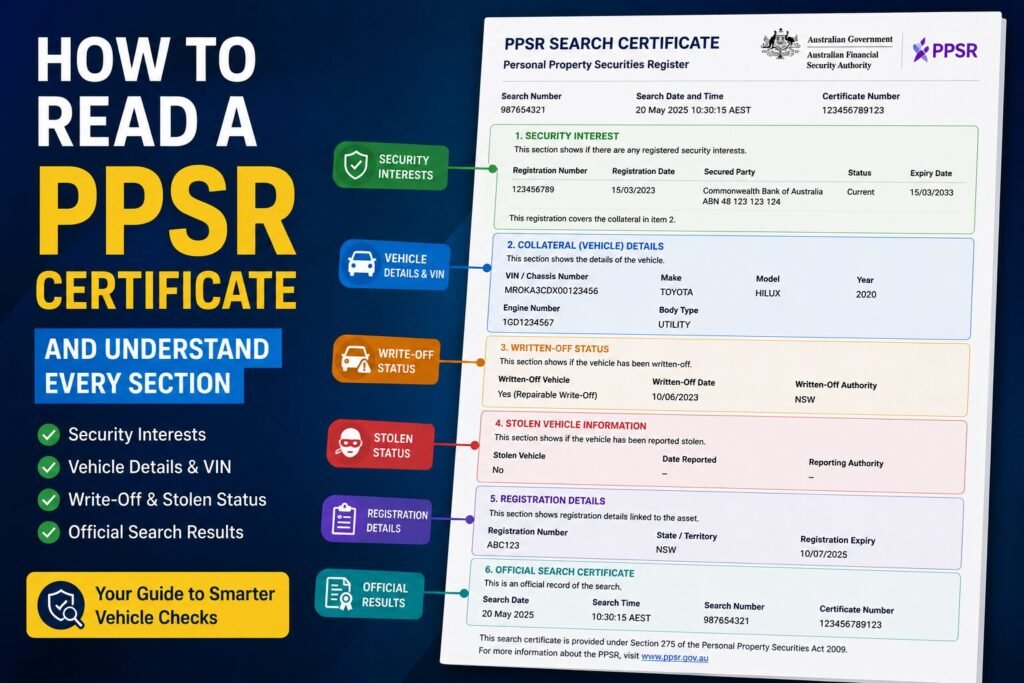
How to Read a PPSR Certificate and Understand Every Section
A PPSR check tells you one thing that matters more than almost anything else in a used car purchase: does someone else have a legal claim on this vehicle? The Personal Property Securities Register is the Australian Government’s official database for recording security interests over personal property, run under the Personal Property Securities Act 2009 and administered by the Australian Financial Security Authority (AFSA).
Here’s the thing: most buyers know PPSR exists but never actually run one. They check the odometer, they check the paint, they read the seller’s story and skip the one search that would actually tell them whether the car is legally theirs to buy.
This guide walks through how to search by VIN or registration, what each line of the report actually means, what it costs, and where buyers commonly get tripped up. It covers vehicles specifically.
What Is a PPSR Check and Why Does It Matter?
A PPSR check searches Australia’s national register to show whether a vehicle, or other personal property, carries a registered security interest, a stolen report, or a written-off record. A clear result generally means none of those flags apply at the time of the search. For the full breakdown of how the register works, what it covers, and who runs it, read our complete guide: What Is PPSR? The Ultimate Guide to Australia’s Personal Property Securities Register.
How to Run a PPSR Check
Running a check takes a couple of minutes: locate the vehicle’s VIN, search it on the official PPSR register, pay the small government fee, and download your certificate before you hand over any money. For the full step-by-step walkthrough, including exactly where to find the VIN and how to avoid the most common search mistakes, read: How to Perform a PPSR Search.
What Can a PPSR Report Show?
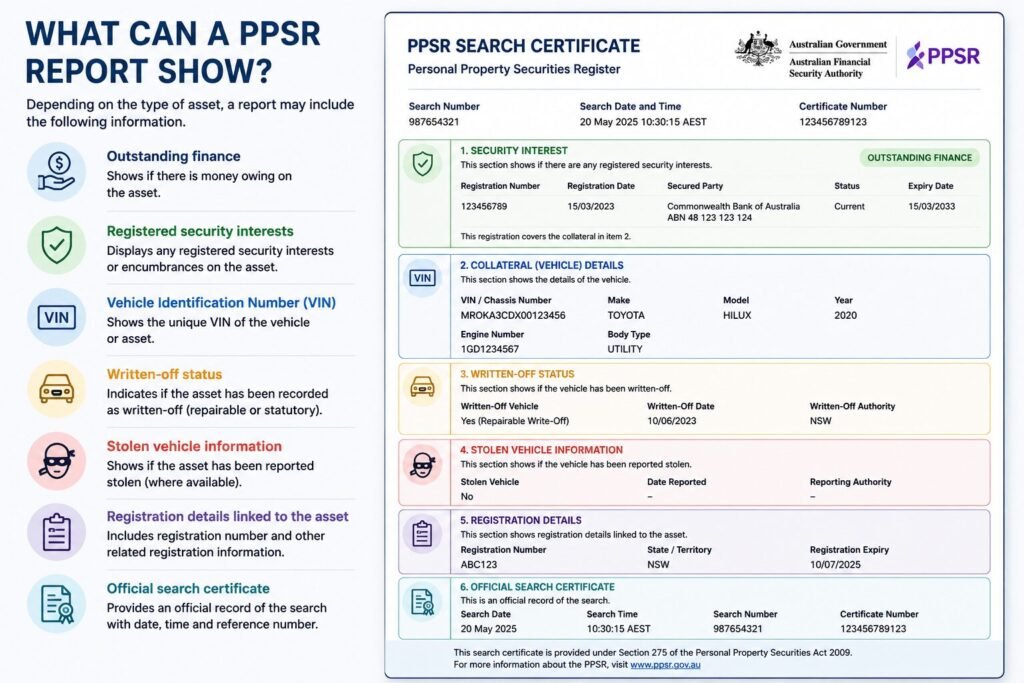
Depending on the type of asset, a report may include:
- Outstanding finance
- Registered security interests
- Vehicle Identification Number (VIN)
- Written-off status
- Stolen vehicle information (where available)
- Registration details linked to the asset
- Official search certificate
Look if you’re buying from a private seller, here’s what actually works. Always ask for the VIN first, then run your own PPSR search rather than relying on screenshots the seller provides.
How to Read Your PPSR Report
Reading a certificate comes down to four things: the security interest section (any registered finance), the vehicle details (confirming the VIN, make, and model match), the written-off status (statutory versus repairable), and stolen vehicle information. A clear report shows none of these flags. If a security interest appears, request a discharge letter before paying; if a write-off shows up, the category matters more than the fact itself, since a repairable write-off can still legally return to the road.
We’ve broken each of these down in dedicated guides: PPSR Certificate Sample Explained, What Is a Security Interest?, and Written-Off vs Repairable.
PPSR vs REVS: What’s the Difference?
REVS, the old Register of Encumbered Vehicles, was folded into the national PPSR system back in 2011. If someone mentions a “REVS check” today, they mean a PPSR search under the old branding, there’s no separate system left to check. Read the full comparison: PPSR vs REVS Check.
What Does a PPSR Check Cost, and Is It Worth Paying More?
The official government fee is a flat $2 per search, whether you’re checking a car, boat, or trailer. Third-party sites often charge $10 to $35 for a “comprehensive report,” which usually just adds an odometer check rather than extra PPSR data. For the full cost breakdown, including when the extra fee is actually worth paying, see: How Much Does a PPSR Check Cost? and Why Does a PPSR Check Cost $2?
Common PPSR Mistakes to Avoid
Buying a used vehicle can move quickly.
Don’t rush.
Avoid these common mistakes:
- Running a search after paying the seller.
- Accepting a screenshot instead of downloading your own certificate.
- Entering the registration number when the VIN is available.
- Ignoring a registered security interest.
- Skipping an independent mechanical inspection.
- Assuming private sellers have complete ownership documentation.
Users who’ve relied only on verbal assurances often report discovering finance issues too late to avoid a difficult dispute.
If you’re unsure about a security interest or its discharge process, speak with the lender directly or a solicitor before completing the purchase.
Frequently Asked Questions
Conclusion
A PPSR check is cheap, fast, and honestly the one step buyers keep skipping when they shouldn’t. Two dollars and a few minutes can tell you whether a car is carrying hidden finance, a stolen report, or a write-off flag information no seller’s word can substitute for.
Run the search close to settlement, use the VIN over the registration number when you can, and don’t hand over money until any security interest is sorted. Get that right, and you’ve covered the one risk that actually costs buyers thousands.
More PPSR Guides
- What Happens If You Skip a PPSR Check? Real Risks and Case Scenarios
- Common Mistakes People Make When Reading a PPSR Certificate
- PPSR and Deceased Estate Sales: What Buyers Need to Know
- Buying a Car from a Rental or Fleet Company: What a PPSR Check Reveals
- PPSR Check for Heavy Vehicles and Trucks: A Buyer’s Guide
- Grey Imports and PPSR: What to Check Before Buying an Imported Vehicle in Australia
- PPSR Search by VIN vs Chassis Number vs Serial Number: What’s the Difference?
- How to Remove a Registered Security Interest After Paying Off a Car Loan
- Auction House Cars: Do You Still Need a PPSR Check?
- PPSR Check for Farm Machinery and Tractors: A Buyer’s Guide
- How Long Does a PPSR Check Take and How Long Is the Certificate Valid?
- Writs, Judgments and Court Orders on a PPSR Check: What They Mean
- Buying a Car on Facebook Marketplace or Gumtree: Safety Tips and PPSR Checks
- Motorcycle PPSR Check: How to Buy a Second-Hand Bike Safely
- Repossessed and Bank-Seized Cars: What to Check Before You Buy
- Buying a Car Interstate in Australia: PPSR, Rego Transfer and What to Know
- How to Spot Odometer Fraud: Checking a Car’s Mileage History
- The Ultimate Used Car Buying Checklist for Australian Buyers
- VIN Check Australia: How to Decode and Verify a Vehicle Identification Number
- How to Check if a Car Is Stolen in Australia (Free and Paid Methods)
- Written-Off vs Repairable: How to Check a Car’s Damage History Before You Buy
- PPSR Check for Business Buyers: Protecting Your Company When Purchasing Equipment or Assets
- Private Seller vs Dealer: Who’s Responsible for Existing Finance on a Used Car?
- PPSR Check for Boats, Caravans and Trailers: A Buyer’s Guide
- Buying a Car with Finance Owing: What Happens and How to Protect Yourself
- Why Does a PPSR Check Cost $2? Understanding the Fee and What You Get
- How Much Does a PPSR Check Cost? Complete Guide to PPSR Fees in Australia
- PPSR vs REVS Check: What’s the Difference and Which One Do You Need in Australia?
- Personal Property Securities Register (PPSR) Explained: The Complete Guide for Australian Buyers and Businesses
- What Is a Security Interest? A Complete Guide for PPSR and Used Vehicle Buyers in Australia
- PPSR Certificate Sample Explained: How to Read and Understand Every Section
- PPSR Registration Explained
- How to Perform a PPSR Search
- What Is PPSR? The Ultimate Guide to Australia’s Personal Property Securities Register
Ready to Check Before You Buy?
Run a fast, official PPSR search now and move forward with confidence.
Check Now