What Is a Security Interest? A Complete Guide for PPSR and Used Vehicle Buyers in Australia
If you’re researching the Personal Property Securities Register (PPSR) or have recently completed a PPSR search, you’ve probably come across the term security interest. It’s one of the most important concepts on a PPSR certificate, yet it’s also one of the most misunderstood.
Many people assume that a security interest means a vehicle has been stolen, has unpaid debts, or cannot legally be sold. In reality, a security interest is simply a legal claim over personal property that helps protect a lender or another party when money is owed or contractual obligations exist.
Understanding what a security interest is and what it isn’t is essential if you’re buying a used car, financing equipment, or reviewing a PPSR certificate. This guide explains security interests in plain English, including how they work, why they are registered on the PPSR, and what they mean for buyers and businesses in Australia.
What Is a Security Interest?
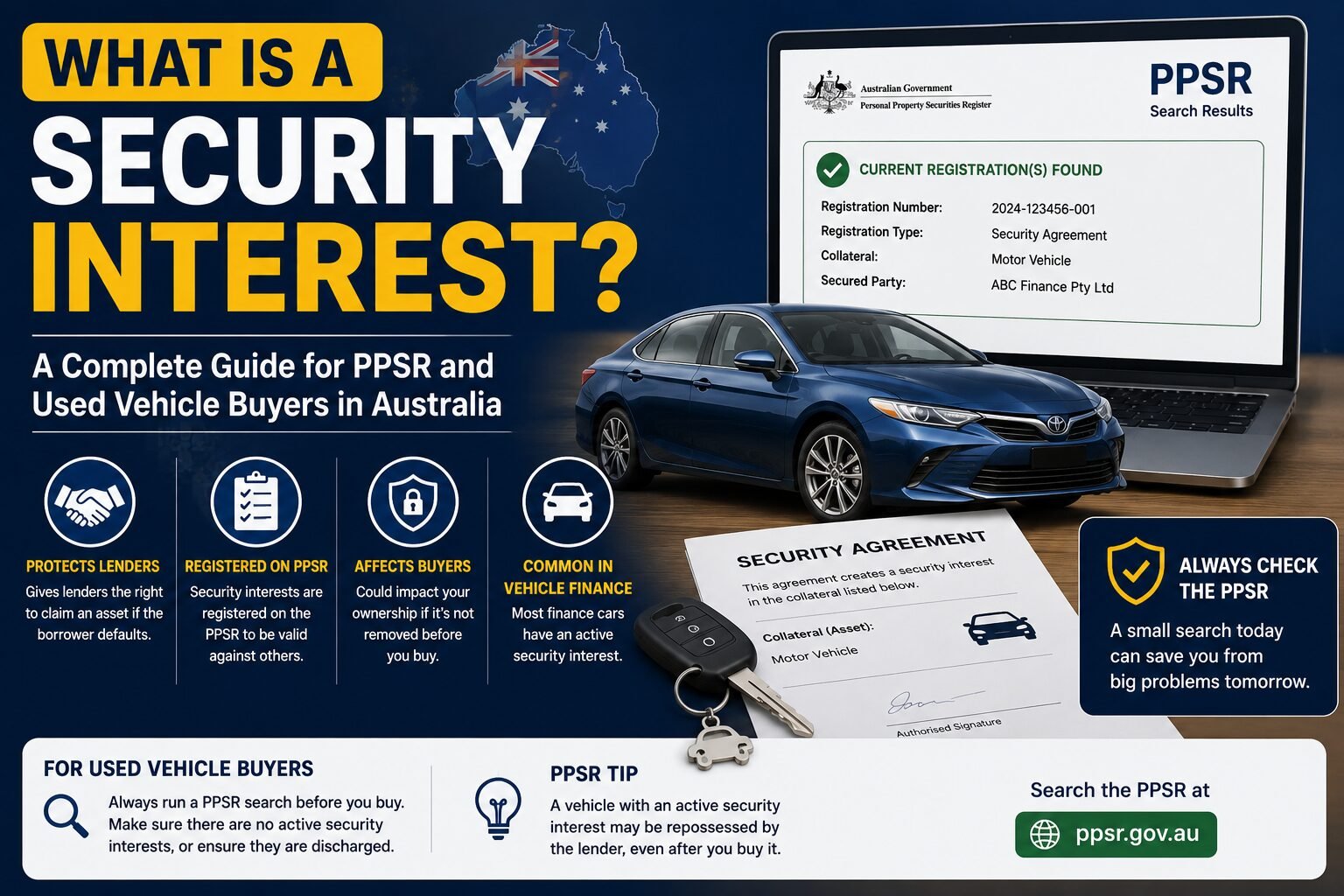
A security interest is a legal right or claim over personal property that secures payment of a debt or the performance of another obligation.
In simple terms, when someone borrows money to purchase a car, truck, caravan, boat, or business equipment, the lender may register a security interest over that asset. This registration helps protect the lender until the borrower has fulfilled the terms of the agreement.
For example, if someone finances a used car through a bank, the bank may register a security interest on the PPSR. Once the loan has been repaid and the lender no longer needs legal protection, the registration can be discharged.
What Is Personal Property?
To understand security interests, you first need to understand personal property.
Personal property refers to valuable assets that are not land or buildings.
Examples include:
- Cars
- Motorcycles
- Trucks
- Boats
- Caravans
- Trailers
- Farm machinery
- Construction equipment
- Business equipment
- Aircraft
- Livestock
- Inventory
- Office equipment
- Intellectual property
Many of these assets can be bought, sold, leased, financed, or used as security for loans.
Why Do Security Interests Exist?
Security interests exist to protect lenders and businesses from financial loss.
Imagine a bank lends $40,000 to someone buying a vehicle. Without legal protection, the borrower could sell the vehicle before repaying the loan.
A registered security interest gives the lender legal rights relating to the asset until the agreed obligations are met.
This system helps reduce lending risk and makes vehicle and equipment financing more secure.
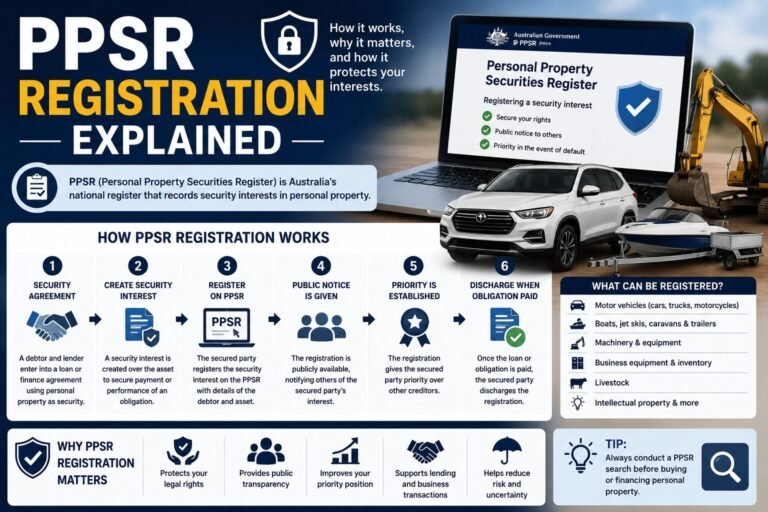
How Does a Security Interest Work?
The process is relatively straightforward.
- A borrower purchases an asset.
- A lender provides finance.
- The lender registers a security interest on the PPSR.
- The borrower makes repayments.
- Once the loan or obligation has been satisfied, the registration can be discharged.
During the registration period, the lender’s interest appears on a PPSR search.
Real-Life Example
Suppose Sarah purchases a used SUV worth $35,000.
She pays:
- $5,000 deposit
- $30,000 financed by a bank
The bank registers a security interest over the SUV on the PPSR.
Five years later, Sarah finishes repaying the loan.
The bank removes (discharges) the security interest.
Future PPSR searches should no longer show that registration.
What Types of Agreements Create Security Interests?
Security interests are not limited to car loans.
Common examples include:
Vehicle Finance
Banks and finance companies frequently register security interests over financed vehicles.
Equipment Finance
Businesses often finance machinery, excavators, tractors, forklifts, and commercial equipment.
Hire Purchase Agreements
Ownership may remain with the lender until all payments are completed.
Commercial Leasing
Some leased assets may have security interests registered.
Business Loans
Business owners sometimes use equipment or inventory as security for loans.
Retention of Title Arrangements
Suppliers may retain a legal interest in goods until invoices have been paid in full.
This is common in wholesale and commercial transactions.
Who Can Register a Security Interest?
Various organisations may register security interests, including:
- Banks
- Credit unions
- Finance companies
- Vehicle leasing companies
- Equipment finance providers
- Commercial lenders
- Manufacturers
- Suppliers
- Businesses
- Government entities (in certain circumstances)
The person or organisation registering the interest is known as the secured party.
What Is the PPSR?
The Personal Property Securities Register (PPSR) is Australia’s national online register of security interests in personal property.
Instead of recording ownership, the PPSR records legal interests held by lenders, suppliers, and other secured parties.
When someone performs a PPSR search, they can determine whether security interests are currently registered against a vehicle or other personal property.
Why Are Security Interests Registered on the PPSR?
Registering a security interest provides important legal protection.
Registration helps:
- Protect lenders.
- Establish priority over other creditors.
- Reduce disputes.
- Increase transparency.
- Support responsible lending.
- Assist buyers with due diligence.
Without registration, a secured party may lose important legal rights if the borrower becomes insolvent or sells the property.
Does a Security Interest Mean Money Is Still Owed?
Not necessarily.
A current registration does not automatically mean that money is still outstanding.
Possible situations include:
- The loan is still active.
- The loan has been repaid, but the registration has not yet been discharged.
- The registration relates to another commercial arrangement.
- The secured party has not yet updated the register.
This is why buyers should ask questions rather than making assumptions.
Does a Security Interest Mean You Should Not Buy the Vehicle?
Not always.
Many vehicles with registered security interests are sold legitimately.
However, before proceeding, buyers should:
- Ask the seller why the registration exists.
- Request evidence if finance has been repaid.
- Confirm whether the registration will be discharged before settlement.
- Keep copies of all documentation.
Never rely solely on verbal assurances.
What Happens If You Buy a Vehicle With a Security Interest?
The consequences depend on the circumstances and applicable laws.
Purchasing an asset without understanding existing security interests can create unnecessary complications.
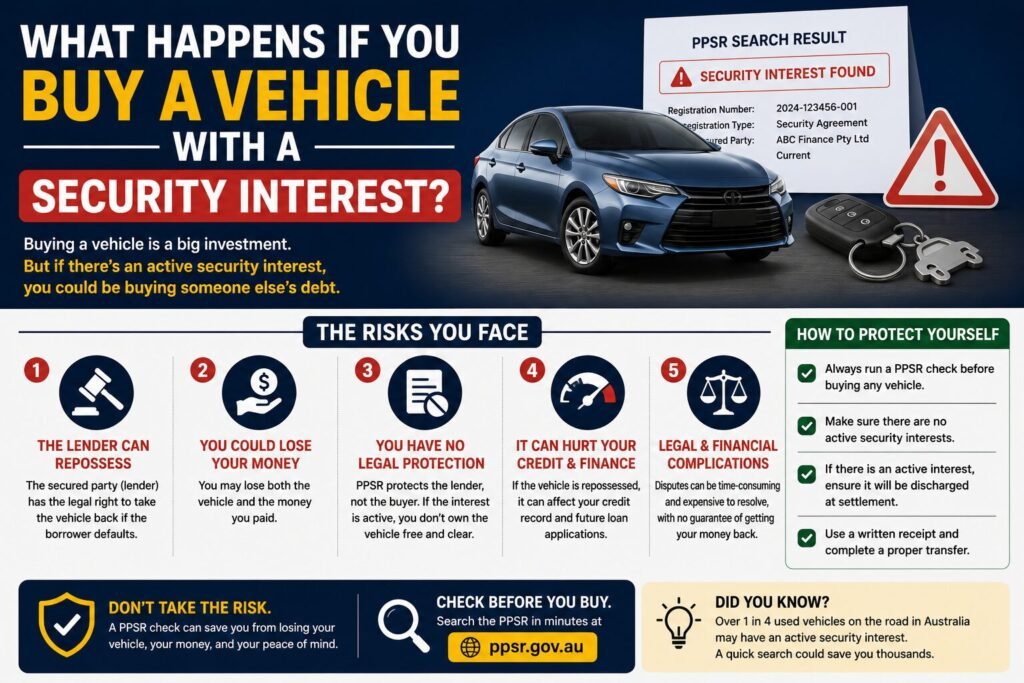
Before completing a purchase, it is generally advisable to:
- Conduct a PPSR search.
- Review the certificate carefully.
- Clarify any current registrations with the seller.
- Obtain professional advice if needed.
These steps help buyers make informed decisions and reduce potential risks.
How Do You Find Security Interests?
The easiest way is by conducting a PPSR search.
For vehicles, searches are usually completed using the:
- Vehicle Identification Number (VIN)
Other assets may be searched using:
- Serial numbers
- Organisation details
- Grantor information
The search results are provided in a PPSR certificate.
How Long Does a Security Interest Last?
Security interests remain registered until one of the following occurs:
- The registration expires.
- The secured party discharges the registration.
- The registration is amended or removed.
Different registrations may have different durations depending on the underlying transaction.
What Is a Discharged Security Interest?
A discharged security interest means the registration has been removed from the PPSR.
This generally occurs after:
- A vehicle loan has been repaid.
- Equipment finance has ended.
- Contractual obligations have been fulfilled.
A discharged registration is no longer current.
What Is a Perfected Security Interest?
A perfected security interest is a legal term used under the Personal Property Securities Act (PPSA).
Generally, perfection refers to taking the necessary legal steps—such as registration or possession to strengthen and protect a secured party’s rights against third parties.
This concept is primarily relevant to lenders, lawyers, insolvency professionals, and commercial transactions.
Common Types of Property That May Have Security Interests
Security interests may be registered over many types of personal property, including:
- Passenger vehicles
- SUVs
- Motorcycles
- Trucks
- Caravans
- Boats
- Jet skis
- Farm machinery
- Excavators
- Bulldozers
- Cranes
- Forklifts
- Manufacturing equipment
- Business inventory
- Livestock
- Intellectual property
- Aircraft
Security Interest vs Ownership
One of the biggest misconceptions is that a security interest proves ownership.
It does not.
| Ownership | Security Interest |
| Identifies who owns the asset | Identifies who has a legal claim over the asset |
| Usually shown by purchase documents | Registered on the PPSR |
| Can change through sale | Exists independently of ownership |
| Does not automatically appear on PPSR | Specifically recorded to protect secured parties |
Understanding this distinction is essential when reading a PPSR certificate.
Common Misunderstandings About Security Interests
“Every financed car has outstanding debt.”
Not necessarily. The registration may simply not have been discharged yet.
“A security interest means the car is stolen.”
No. Stolen vehicle information and security interests are different matters.
“Only banks register security interests.”
Many organisations, including suppliers and commercial lenders, may register them.
“Security interests only apply to cars.”
No. They apply to a wide range of personal property.
“The PPSR records ownership.”
No. The PPSR records registered security interests, not ownership.
Why Security Interests Matter When Buying a Used Vehicle
Checking for security interests is one of the most important steps before purchasing a used vehicle.
It helps buyers:
- Understand whether legal claims are registered.
- Ask informed questions.
- Identify situations requiring further investigation.
- Keep records of due diligence.
- Purchase with greater confidence.
Combined with a mechanical inspection, VIN verification, service history, and ownership documentation, a PPSR search forms an important part of responsible vehicle buying.
Frequently Asked Questions
Is a security interest the same as finance owing?
Not always. While many security interests relate to finance agreements, they can also arise from leases, supplier agreements, business loans, or other commercial arrangements.
Can a vehicle have more than one security interest?
Yes. Multiple secured parties may register interests over the same asset in certain situations.
How do I know if a security interest exists?
You can conduct a PPSR search using the vehicle’s VIN or another applicable identifier. The resulting PPSR certificate will indicate whether any current registrations are recorded.
Can a security interest be removed?
Yes. Once the underlying obligation has been satisfied, the secured party can discharge the registration.
Does every used vehicle have a security interest?
No. Many used vehicles have no current security interests recorded on the PPSR.
Conclusion
A security interest is a legal mechanism designed to protect lenders, suppliers, and other secured parties when personal property is used as security for a loan or contractual obligation. While the term may sound intimidating, a security interest does not automatically mean there is a problem with the vehicle or asset you are considering.
The key is to understand what the registration means, review your PPSR certificate carefully, and ask questions if a current security interest is recorded. By combining a PPSR search with other due diligence steps such as verifying the VIN, inspecting the vehicle, and reviewing ownership documents you can make more informed decisions and reduce the risks associated with buying valuable personal property in Australia.