Personal Property Securities Register (PPSR) Explained: The Complete Guide for Australian Buyers and Businesses
Whether you’re buying a used car, financing business equipment, or running a company that sells goods on credit, you’ve likely come across the Personal Property Securities Register (PPSR). While it may sound like a complicated legal system, the PPSR is simply Australia’s national register that records security interests in personal property.
For many Australians, the PPSR becomes important when purchasing a used vehicle. A quick PPSR search can help identify whether a car has a registered security interest, giving buyers valuable information before completing a purchase. However, the PPSR is much more than a vehicle checking service it also plays a significant role in commercial finance, lending, leasing, and business transactions across Australia.
This comprehensive guide explains what the Personal Property Securities Register is, how it works, why it exists, and why understanding it is essential for buyers, sellers, lenders, and businesses.
What Is the Personal Property Securities Register (PPSR)?
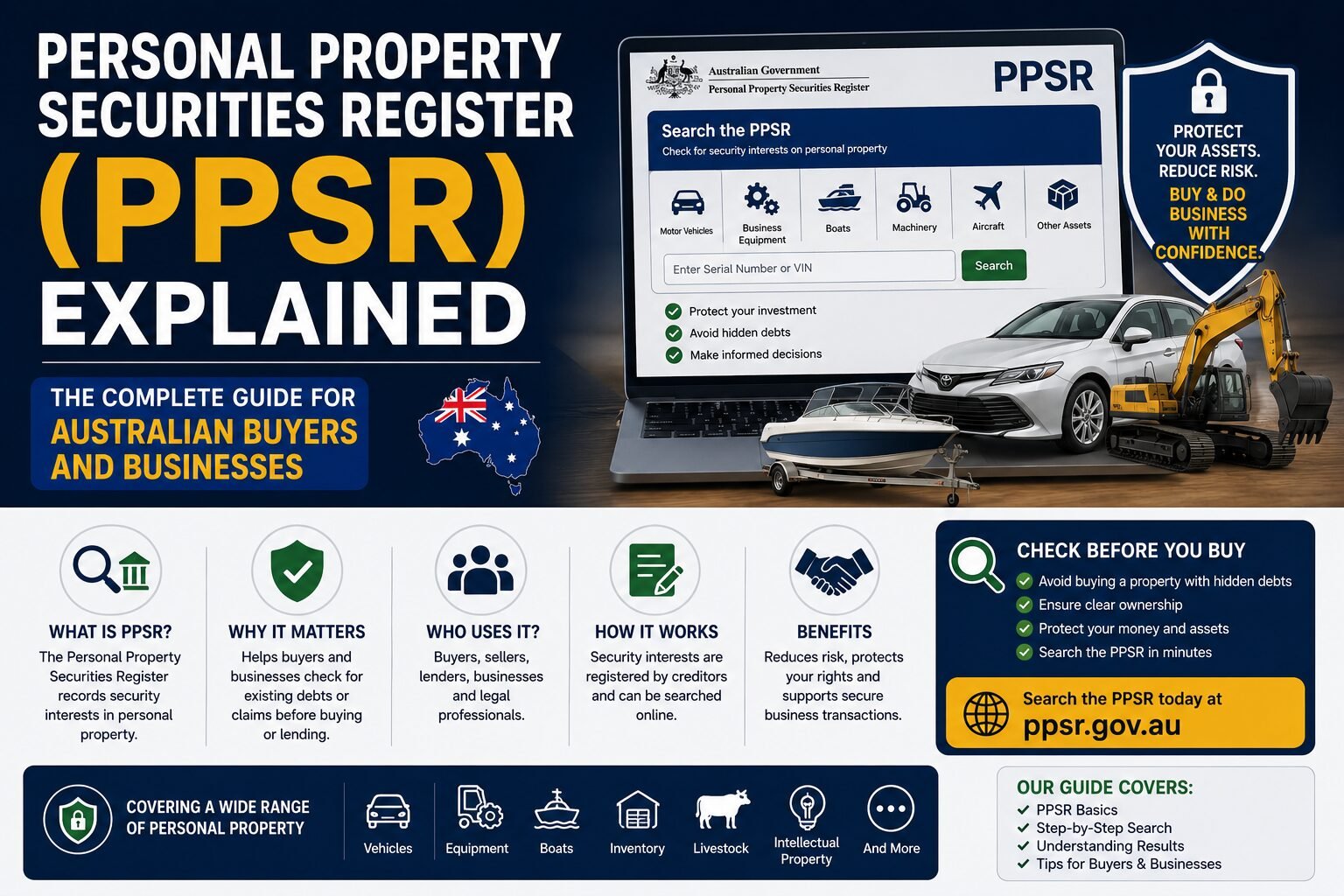
The Personal Property Securities Register (PPSR) is Australia’s official online register that records security interests in personal property.
Rather than recording who owns an asset, the PPSR records whether another party such as a bank, finance company, supplier, or lender has a registered legal interest in that property.
The register operates nationwide and provides a central system for recording security interests over a wide range of personal property.
Examples include:
- Cars
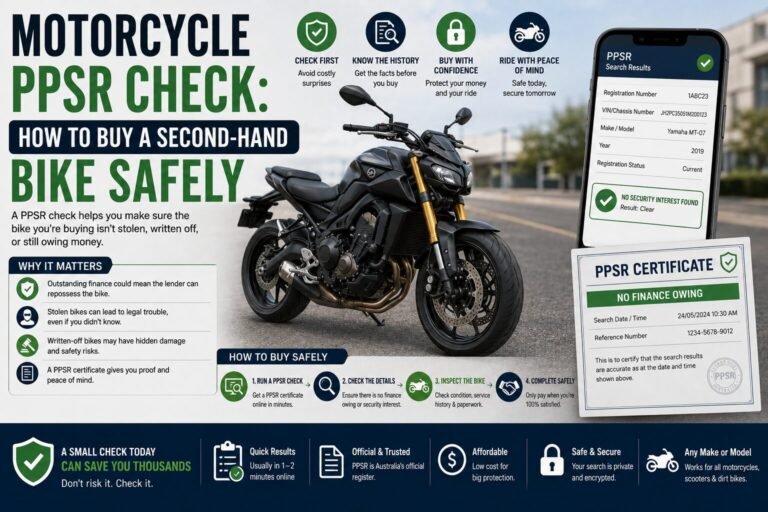
- Motorcycles
- Trucks
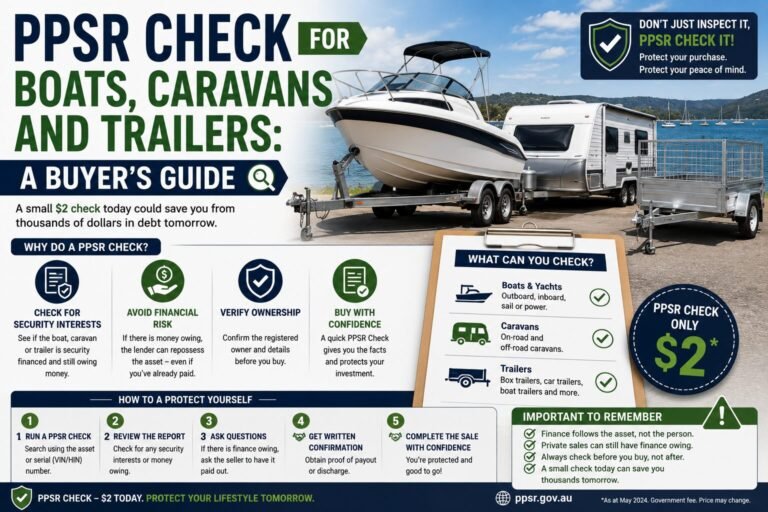
- Caravans
- Boats
- Trailers
- Farm machinery
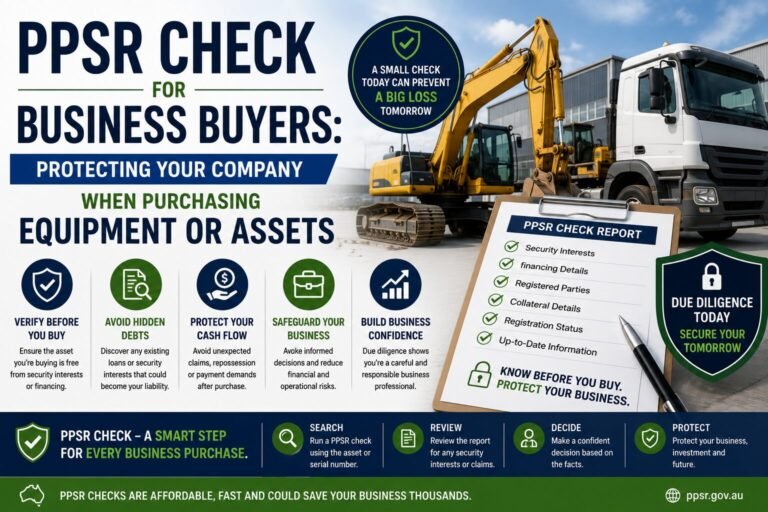
- Construction equipment
- Business equipment
- Aircraft
- Livestock
- Inventory
- Intellectual property
The PPSR is an important part of Australia’s secured lending system and helps promote transparency in commercial transactions.
What Does PPSR Stand For?
PPSR stands for Personal Property Securities Register.
It is closely connected with the Personal Property Securities Act 2009 (PPSA), which provides the legal framework governing security interests in Australia.
Why Was the PPSR Created?
Before the PPSR existed, Australia had multiple state and territory registers for recording security interests.
This created several challenges:
- Different rules across jurisdictions
- Multiple registration systems
- Increased legal complexity
- Higher administrative costs
- Greater risk of disputes
To simplify the process, Australia introduced a single national register under the Personal Property Securities Act.
The PPSR provides one consistent system that can be used throughout the country.
What Is Personal Property?
The term personal property refers to property other than land or buildings.
It includes tangible and intangible assets such as:
Motor Vehicles
- Cars
- SUVs
- Motorcycles
- Trucks
- Vans
- Buses
Recreational Vehicles
- Boats
- Caravans
- Jet skis
- Camper trailers
Commercial Equipment
- Excavators
- Tractors
- Bulldozers
- Cranes
- Forklifts
- Manufacturing equipment
Business Assets
- Office equipment
- Inventory
- Machinery
- Livestock
- Intellectual property
- Accounts receivable
Many of these assets can be financed, leased, or used as security for loans.
What Is a Security Interest?
A security interest is a legal interest in personal property that secures payment of a debt or the performance of another obligation.
For example:
A bank finances the purchase of a vehicle.
The bank registers a security interest on the PPSR.
The registration helps protect the lender while the loan remains active.
Once the borrower satisfies the agreement, the registration can usually be discharged.
How Does the PPSR Work?
The PPSR works by recording security interests against personal property.
The basic process is straightforward.
Step 1: Finance or Commercial Agreement
A borrower purchases property using finance or enters another commercial arrangement.
Step 2: Registration
The secured party registers its interest on the PPSR.
Step 3: Search
Potential buyers, businesses, or lenders can perform a PPSR search.
Step 4: Results
The search produces a PPSR certificate showing whether current registrations exist.
Step 5: Decision
The buyer reviews the results before proceeding with the purchase or transaction.
Why Is the PPSR Important?
The PPSR helps protect both businesses and consumers.
It provides transparency by allowing people to determine whether registered security interests exist before purchasing valuable assets.
Benefits include:
- Better informed purchasing decisions
- Increased transparency
- Protection for lenders
- Reduced commercial disputes
- Improved confidence in business transactions
- National consistency
Who Uses the PPSR?
The PPSR is used by many different groups.
Private Buyers
Individuals buying used vehicles often perform PPSR searches before purchasing.
Car Dealers
Dealerships regularly use the PPSR when acquiring trade-ins or selling used vehicles.
Banks
Banks register security interests when financing vehicles or business assets.
Finance Companies
Finance providers use the PPSR to protect loans.
Businesses
Businesses search and register security interests over commercial equipment and inventory.
Lawyers
Legal professionals use the PPSR during commercial transactions.
Insolvency Practitioners
The register helps identify secured interests during insolvency proceedings.
What Information Does the PPSR Record?
The PPSR records information relating to registered security interests.
Depending on the asset, information may include:
- Registration number
- Registration status
- Registration dates
- Collateral class
- Vehicle Identification Number (VIN)
- Serial number
- Grantor details
- Secured party information
- Registration duration
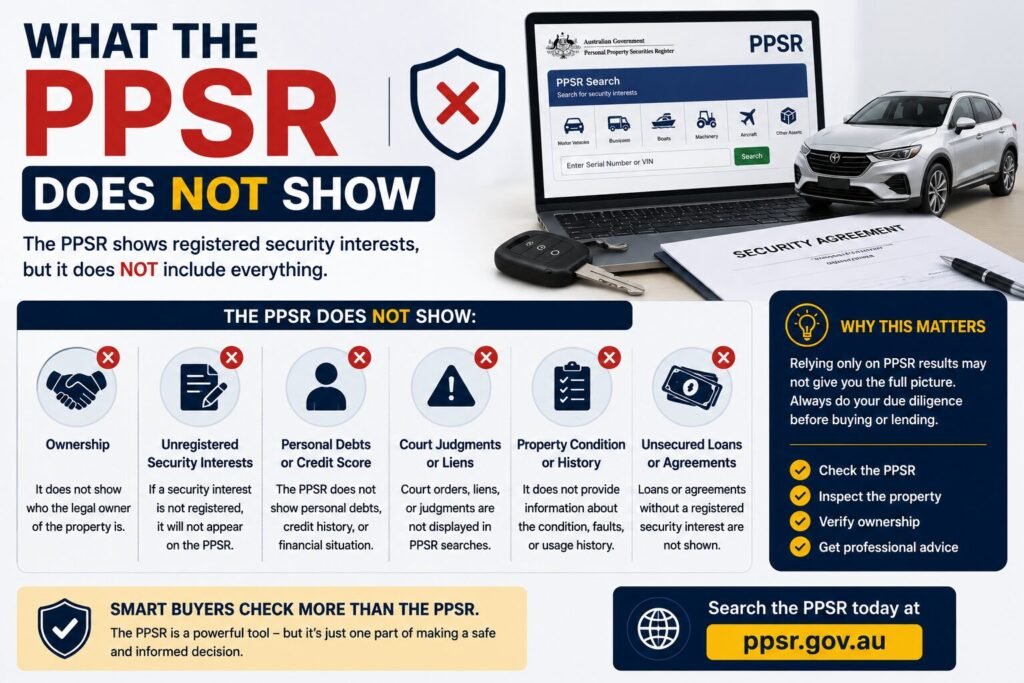
What the PPSR Does Not Show
A common misconception is that the PPSR provides a complete history of a vehicle.
It generally does not record:
- Ownership
- Service history
- Mechanical condition
- Accident history
- Flood damage
- Insurance claims
- Registration status
- Roadworthy condition
- Odometer accuracy
Buyers should perform additional checks before completing a purchase.
When Should You Perform a PPSR Search?
A PPSR search is recommended whenever you purchase valuable personal property.
Common situations include buying:
- Used cars
- Motorcycles
- Trucks
- Boats
- Caravans
- Trailers
- Farm machinery
- Construction equipment
- Commercial vehicles
- Business equipment
Businesses may also search before lending money or acquiring assets.
How to Search the PPSR
Searching the PPSR is a straightforward process.
Step 1
Locate the VIN or serial number.
Step 2
Access the official PPSR search service.
Step 3
Enter the required search information.
Step 4
Complete the applicable payment.
Step 5
Download your PPSR certificate.
Step 6
Review the search results carefully.
Understanding a PPSR Certificate
A PPSR certificate typically includes:
- Search details
- Search date
- Search time
- Search criteria
- Registration status
- Security interests
- Registration details
- Collateral information
- Secured party details
Learning how to read a PPSR certificate is an important part of the buying process.
Common Reasons Security Interests Are Registered
Security interests may arise from:
- Vehicle finance
- Equipment finance
- Business loans
- Commercial leasing
- Hire purchase agreements
- Supplier credit arrangements
- Retention of title agreements
Not every registration indicates that money is still outstanding.
What Happens If a PPSR Search Finds a Security Interest?
If your search identifies a current registration, do not panic.
Instead:
- Ask the seller why it exists.
- Request supporting documentation.
- Determine whether obligations have been satisfied.
- Confirm whether the registration will be discharged.
- Delay the purchase if clarification is required.
Understanding the circumstances is more important than making assumptions.
Advantages of the PPSR
The PPSR offers several benefits.
National Register
One register covers all Australian states and territories.
Greater Transparency
Buyers can identify registered security interests before purchasing.
Protection for Lenders
Lenders gain legal protection for financed assets.
Supports Responsible Lending
The system promotes confidence in commercial finance.
Reduces Commercial Risk
Businesses can make better-informed lending and purchasing decisions.
Limitations of the PPSR
Although valuable, the PPSR has limitations.
It does not replace:
- Mechanical inspections
- Ownership verification
- Vehicle history reports
- Service records
- Roadworthy inspections
- Independent due diligence
The PPSR should be viewed as one important part of a broader purchasing process.
PPSR vs Vehicle History Reports
Many buyers confuse a PPSR search with a vehicle history report.
| PPSR | Vehicle History Report |
| Shows registered security interests | May include ownership history |
| Records legal interests | May include accident history |
| Focuses on secured transactions | May include service information |
| Used for finance due diligence | Used for broader vehicle assessment |
Many buyers choose to use both when purchasing an expensive vehicle.
Common Misunderstandings About the PPSR
“The PPSR proves ownership.”
No.
The PPSR records security interests not ownership.
“Every financed vehicle has outstanding debt.”
Not necessarily.
Some registrations remain on the register temporarily after repayment.
“Only banks use the PPSR.”
Many businesses, suppliers, leasing companies, and finance providers also register security interests.
“The PPSR only covers cars.”
The PPSR covers many types of personal property beyond motor vehicles.
Frequently Asked Questions
Is the PPSR only for vehicles?
No. The PPSR covers a wide range of personal property, including commercial equipment, machinery, livestock, inventory, and intellectual property.
Does a PPSR search guarantee a vehicle is safe to buy?
No. A PPSR search identifies registered security interests but does not assess the vehicle’s condition, history, or ownership.
Can private buyers use the PPSR?
Yes. Many private buyers perform PPSR searches before purchasing used vehicles.
Does the PPSR show outstanding finance?
A current security interest may relate to a finance agreement or another commercial arrangement. Buyers should review the certificate carefully and seek clarification from the seller if necessary.
Is the PPSR available throughout Australia?
Yes. The PPSR is a national register that applies across all Australian states and territories.
Conclusion
The Personal Property Securities Register (PPSR) is a vital part of Australia’s secured lending and commercial transaction system. By recording security interests in personal property, it provides buyers, businesses, lenders, and finance providers with valuable information that supports informed decision-making and helps reduce risk.
Whether you’re buying a used car, financing equipment, or managing business assets, understanding how the PPSR works can help you navigate transactions with greater confidence. While a PPSR search is an important due diligence tool, it should always be combined with other checks such as verifying ownership, inspecting the asset, and reviewing service or maintenance records to ensure you have a complete picture before committing to a purchase.