
Buying a Car with Finance Owing: What Happens and How to Protect Yourself
A PPSR search comes back and there it is: a registered security interest against the car you were about to buy. For a lot of buyers, that’s the moment a straightforward private sale suddenly feels complicated. The good news is that finance showing up on a report isn’t automatically a deal-breaker, and it isn’t proof anyone is trying to cheat you. It just means there’s a process to follow before any money changes hands.
What “Finance Owing” Actually Means on a PPSR Report
When your search shows a registered security interest, it means a lender has recorded a legal claim over that specific vehicle, usually because the current owner took out a loan and used the car as security for it. The finance company is called the secured party, and the person who owns the car (and technically owes the debt) is the grantor. Until that loan is paid out and the registration is removed, the lender’s claim technically follows the car, not just the person who borrowed the money.
How Cars End Up Being Sold With Finance Still Attached
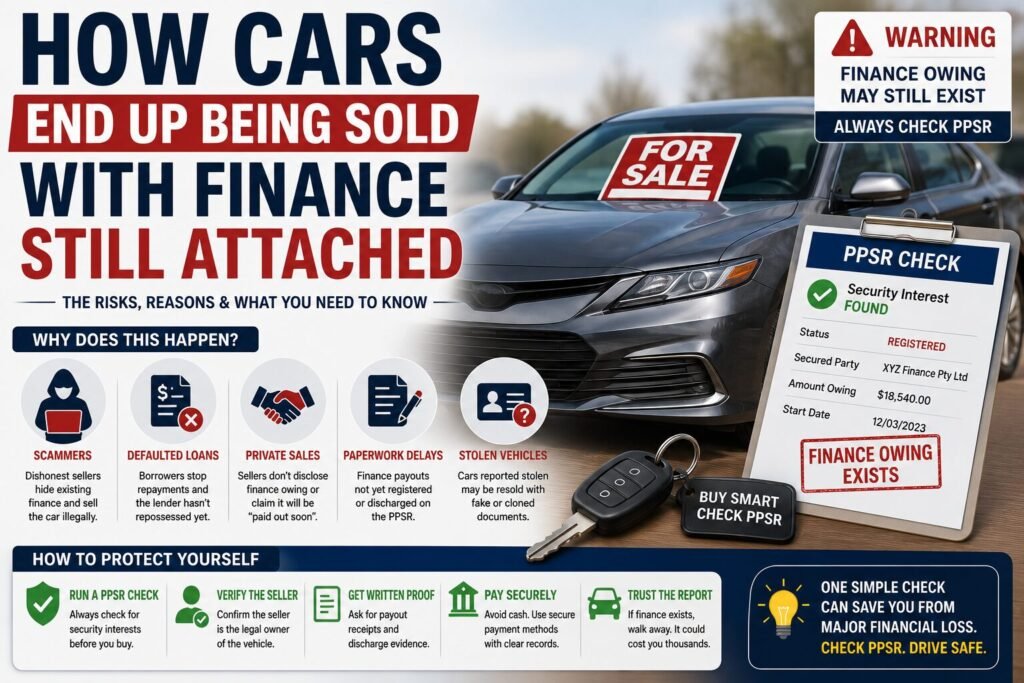
Most of the time this isn’t malicious. Sellers refinance a car, forget an old loan was never formally discharged, or genuinely believe a trade-in dealer cleared the debt when they didn’t. Dealer trade-ins occasionally slip through without the paperwork catching up. Deliberate fraud, where someone knowingly sells a financed car without telling the buyer, does happen, but it’s the less common explanation and PPSR is exactly the tool that catches it either way.
Your Rights and Risks as a Buyer
Buying a car privately doesn’t automatically give you a clean title if a security interest is still registered. In some circumstances a lender can still repossess a vehicle from a buyer who purchased it in good faith, which is precisely why checking before you pay matters so much more than checking after. A clear PPSR result at the time of purchase is one of the strongest protections available to a private buyer under the Personal Property Securities Act.
Step-by-Step: What to Do When Finance Shows Up on a PPSR Report
Don’t cancel the sale immediately, but don’t hand over money either. Work through it properly first.
- Contact the seller and ask them to explain the registered interest directly.
- – Request a written payout figure and a discharge letter from the finance company named on the report.
- – Arrange for the loan to be paid out and the security interest formally removed at or before settlement.
- – Run a second PPSR search after settlement to confirm the registration has actually been discharged.
- – Get everything in writing, never rely on a verbal promise that “it’s already sorted.”
Once you’ve confirmed the process, you can use the checker on this homepage to run your own independent search rather than relying on a screenshot the seller provides.
Can a Finance Company Repossess a Car You’ve Already Paid For?
Yes, in some cases, which is exactly why timing matters. If a security interest remains registered after you’ve bought and paid for the vehicle, the finance company can, in certain circumstances, still repossess it to recover the debt, leaving you to chase the seller for a refund. That’s a far worse position than pausing a sale for a week while a discharge letter comes through.
Red Flags to Watch For Before You Pay
- A seller who pushes for a rushed, cash-only settlement before you’ve had time to verify anything.
- – Reluctance to provide the finance company’s name or a payout figure.
- – A PPSR certificate that looks edited, low-resolution, or was supplied as a screenshot rather than a downloaded PDF.
- – A price that’s noticeably below market value for no clear reason.
- – Pressure to skip an independent mechanical inspection alongside the finance check.
- ## What If You’ve Already Bought the Car and Then Discover Finance Owing?
- Contact the seller immediately and request they clear the debt and provide a discharge letter. If they’re unresponsive, you may need to contact the finance company directly to understand your options, and it’s worth speaking to a solicitor or your state’s consumer affairs office, particularly if the seller misrepresented the vehicle’s finance status at the time of sale. Keep every message, receipt, and certificate; that paper trail becomes essential if the matter escalates.
Faqs
- Does a security interest always mean the seller is being dishonest?
- No. Most of the time it’s an administrative gap, an old loan that was never formally discharged, rather than an attempt to deceive the buyer.
- Can I still negotiate on price if PPSR shows finance owing?
- Yes, though most buyers simply wait until the discharge is confirmed rather than negotiating around an unresolved finance issue.
- How long does it usually take a seller to get a discharge letter?
- It varies by lender, but a few business days is common once the payout figure has been requested.
- Should I use a solicitor for a private sale with a registered interest?
- For anything beyond a small, low-value vehicle, it’s a reasonable precaution, especially if the discharge isn’t confirmed before settlement.
Conclusion:
A registered security interest on a PPSR report isn’t a reason to panic, and it isn’t necessarily a reason to walk away either. It’s a reason to slow down, ask the right questions, and get the discharge confirmed in writing before you pay. The buyers who get burned are almost always the ones who paid first and asked questions later.