PPSR Registration Explained
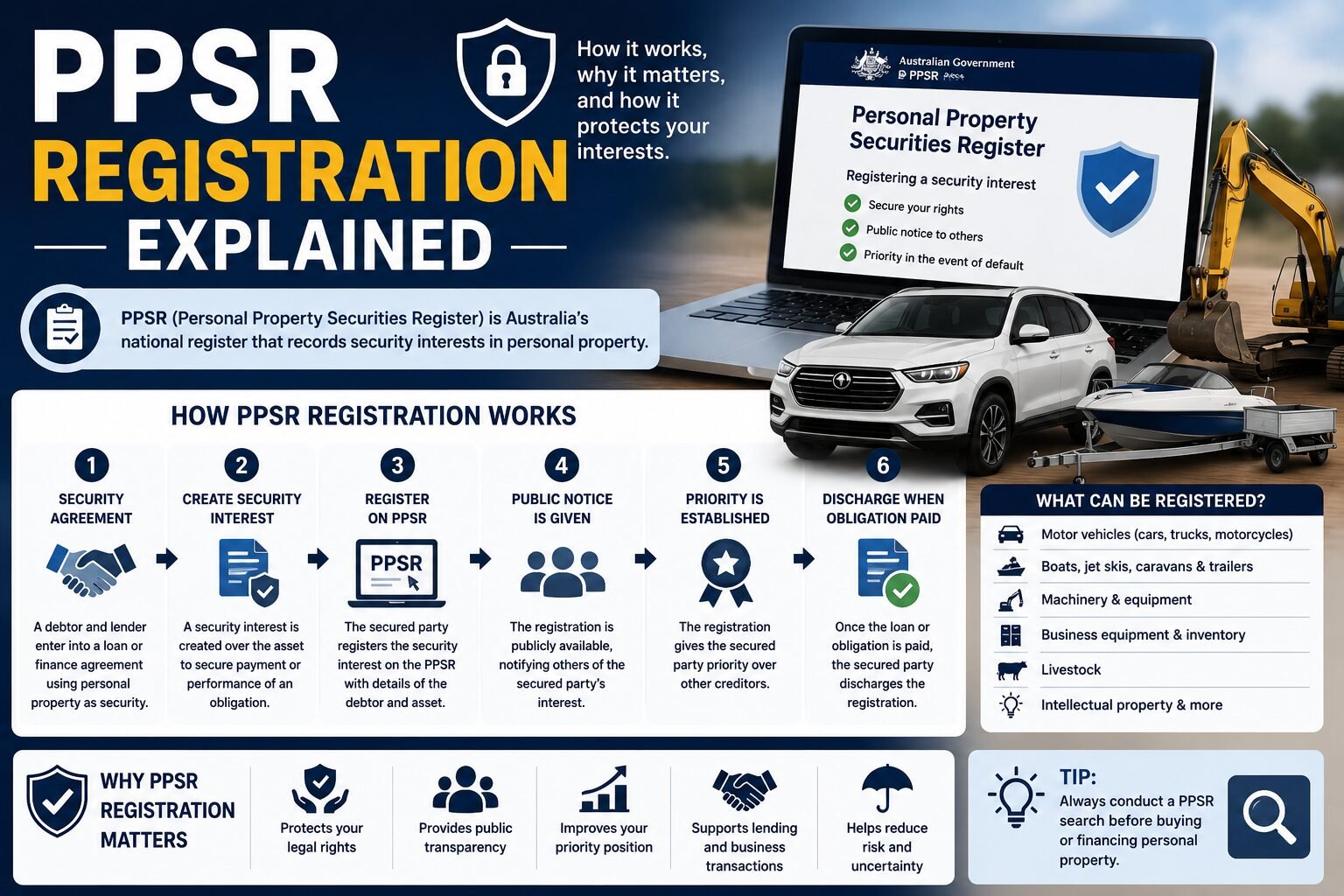
A PPSR registration is the process of recording a security interest against personal property on the Personal Property Securities Register. Registering a security interest gives the secured party public notice of its legal claim over the asset and may strengthen its priority against other creditors if the grantor defaults or becomes insolvent.
The registration itself does not transfer ownership of the property. Instead, it records that another party has a legal interest in the asset because it has been used as security for an obligation.
Businesses, lenders, suppliers, leasing companies, and finance providers commonly register security interests to protect their financial interests.
Types of PPSR Registrations
The PPSR supports various registration types depending on the nature of the transaction.
Motor Vehicle Registrations
These apply to vehicles such as:
- Cars
- SUVs
- Trucks
- Motorcycles
- Vans
- Buses
Vehicle registrations are generally linked to the Vehicle Identification Number (VIN).
Commercial Equipment
Businesses often register security interests over:
- Manufacturing equipment
- Construction machinery
- Mining equipment
- Medical equipment
- Office equipment
This helps protect the lender if payments are not completed.
Agricultural Property
Farm-related assets may include:
- Tractors
- Harvesters
- Balers
- Irrigation systems
- Livestock
- Farm machinery
Many agricultural finance agreements are protected through PPSR registrations.
Inventory
Suppliers may register security interests over inventory supplied on credit.
Examples include:
- Retail stock
- Wholesale products
- Building materials
- Automotive parts
This can help suppliers recover goods if payment is not made.
Intellectual Property
Certain commercial transactions involving intellectual property may also be recorded, including:
- Patents
- Copyright
- Trade marks
- Licences
Who Can Register a Security Interest?
Many organisations and individuals use the PPSR to protect their interests.
Common users include:
- Banks
- Credit unions
- Finance companies
- Vehicle leasing companies
- Equipment finance providers
- Suppliers
- Wholesalers
- Manufacturers
- Small businesses
- Large corporations
Any party with a valid legal security interest may be eligible to register it in accordance with the Personal Property Securities Act.
How Long Does a PPSR Registration Last?
The duration depends on the type of collateral and the registration selected.
Registration periods may range from several years to an indefinite period for certain collateral types.
Once the secured obligation has been satisfied, the secured party should discharge the registration to remove the security interest from the register.
What Is a Discharged Registration?
A discharged registration indicates that the security interest has been removed from the PPSR.
This generally occurs after:
- A loan has been repaid
- A lease agreement has ended
- A finance contract has been completed
- The secured party voluntarily removes the registration
Discharged registrations are no longer current.
Why Businesses Register Security Interests
Businesses use PPSR registrations to reduce financial risk.
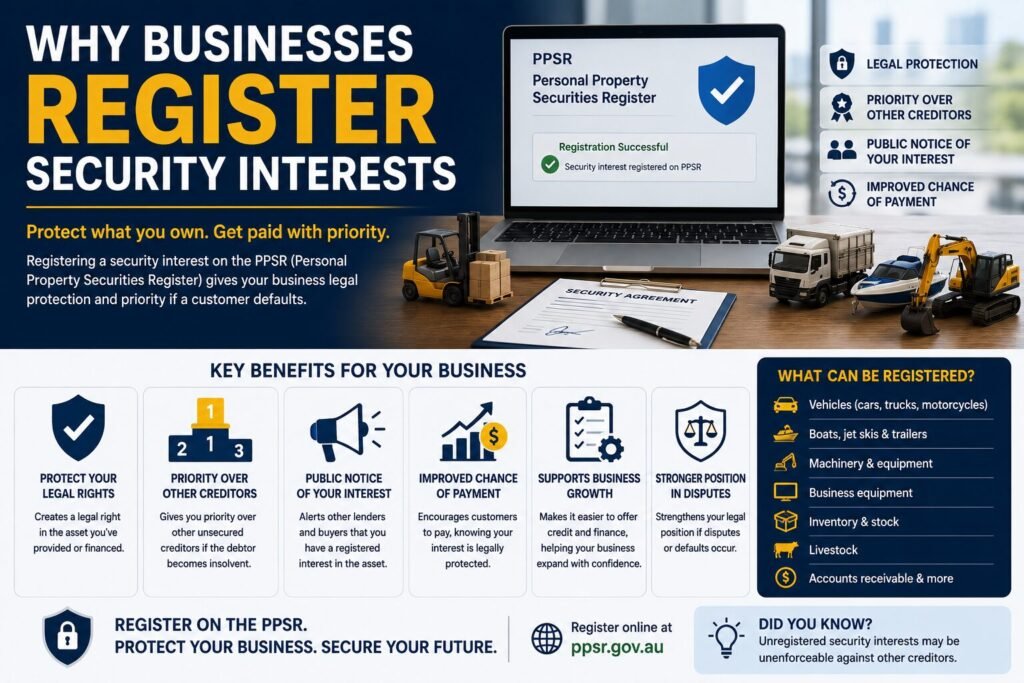
Common reasons include:
- Protecting unpaid invoices
- Securing equipment finance
- Protecting leased assets
- Securing commercial loans
- Protecting goods supplied on credit
Without a valid registration, a business may have fewer legal protections if a customer becomes insolvent.
PPSR and Used Vehicle Purchases
Buying a used vehicle without performing a PPSR search can expose buyers to unnecessary risk.
Before purchasing any used vehicle, consider checking:
- Security interests
- Vehicle Identification Number (VIN)
- Registration documents
- Service history
- Mechanical condition
- Accident history
- Roadworthy certificate (where applicable)
Combining these checks provides a more complete understanding of the vehicle.
PPSR for Car Buyers
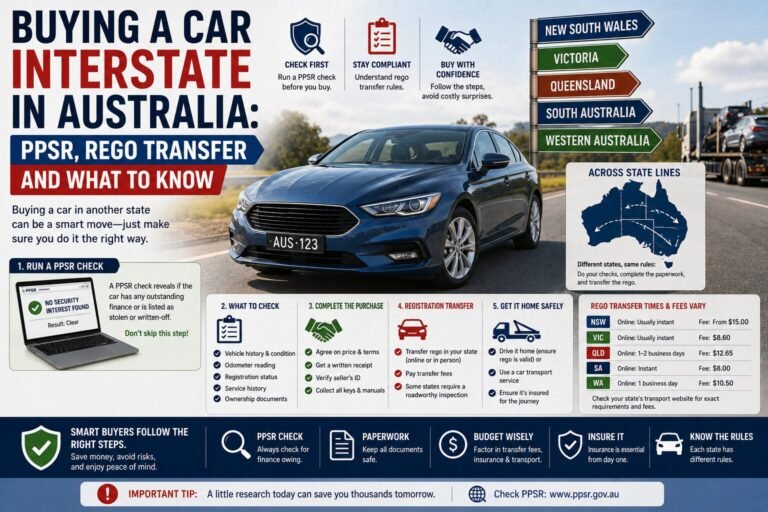
If you’re buying a used car privately, a PPSR search should be part of your purchase checklist.
A search can help you identify whether a current security interest is registered against the vehicle.
It is also good practice to:
- Compare the VIN on the vehicle with the documents.
- Confirm the seller’s identity.
- Review maintenance records.
- Arrange an independent mechanical inspection.
- Complete all paperwork correctly.
Taking these steps reduces the likelihood of unexpected issues after the purchase.
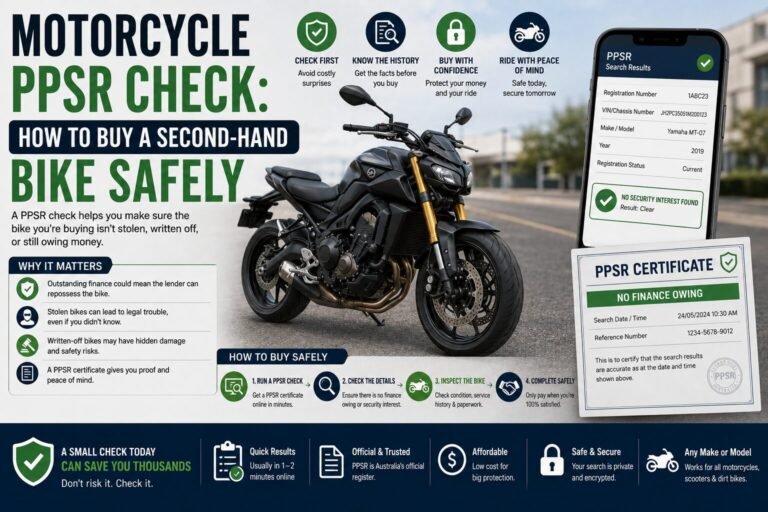
PPSR for Motorcycles
Motorcycles can also be subject to registered security interests.
Before purchasing a used motorcycle:
- Verify the VIN.
- Perform a PPSR search.
- Inspect the motorcycle carefully.
- Review service records.
- Confirm ownership documentation.
These checks are especially important when purchasing through private sellers.
PPSR for Boats and Watercraft
Boats, personal watercraft, and some marine assets may also have security interests registered against them.
Before completing the purchase:
- Confirm the Hull Identification Number (HIN), where applicable.
- Review registration documents.
- Perform a PPSR search if the asset is eligible.
- Request maintenance records.
PPSR for Businesses Buying Equipment
Businesses purchasing second-hand machinery or commercial equipment should perform due diligence before settlement.
Recommended checks include:
- PPSR search
- Serial number verification
- Equipment inspection
- Service history
- Proof of ownership
- Purchase documentation
These checks can help reduce commercial risk.
Advantages of PPSR
The PPSR offers benefits for buyers, lenders, and businesses alike.
Greater Transparency
The register provides information about registered security interests, helping parties make informed decisions.
Reduced Financial Risk
Buyers can identify potential issues before purchasing personal property.
National Register
The PPSR operates across Australia, replacing multiple state-based systems with one central register.
Supports Commercial Lending
Lenders can publicly record their security interests, supporting secured finance transactions.
Encourages Due Diligence
Using the register promotes responsible buying and lending practices.
Limitations of PPSR
Although the PPSR is an important resource, it has limitations.
A PPSR search generally does not confirm:
- Vehicle ownership
- Mechanical condition
- Accident damage
- Flood damage
- Service history
- Odometer accuracy
- Registration status
- Insurance claims
Additional inspections and document checks remain essential before purchasing any used asset.
Common PPSR Myths
Myth 1: A PPSR Search Proves Ownership
False.
The register records security interests, not ownership.
Myth 2: A Clear PPSR Means the Vehicle Is Perfect
False.
A vehicle may still have mechanical issues, accident damage, or other problems not recorded on the register.
Myth 3: Only Banks Use PPSR
False.
Many businesses, suppliers, leasing companies, and finance providers register security interests.
Myth 4: Only Cars Can Be Registered
False.
Many types of personal property can be subject to security interests, including equipment, machinery, boats, livestock, and business assets.
Best Practices Before Buying Personal Property
Before purchasing valuable personal property, consider following this checklist:
- Verify the VIN or serial number.
- Perform a PPSR search.
- Compare all documents with the asset.
- Confirm the seller’s identity.
- Inspect the asset thoroughly.
- Obtain service and maintenance records.
- Keep copies of all purchase documents.
- Save your PPSR certificate for future reference.
Following these steps can help you make a more informed purchasing decision and reduce the likelihood of unexpected issues.
Frequently Asked Questions
What does PPSR stand for?
PPSR stands for Personal Property Securities Register, Australia’s national register for recording security interests in personal property.
Is a PPSR search worth doing?
Yes. A PPSR search is an important part of due diligence when purchasing used vehicles, equipment, or other valuable personal property.
Does PPSR show ownership?
No. The PPSR records security interests, not legal ownership.
Can I search the PPSR before buying a used car?
Yes. Performing a PPSR search before purchasing a used vehicle is widely recommended to help identify registered security interests.
Does a PPSR search show accident history?
No. Accident history and mechanical condition are generally not included in PPSR search results.
Can businesses use the PPSR?
Yes. Businesses frequently use the PPSR to register and search security interests as part of commercial transactions.
Conclusion:
The Personal Property Securities Register (PPSR) is an important tool for protecting buyers, businesses, and lenders throughout Australia. By recording security interests in personal property, it promotes transparency and supports more informed purchasing and lending decisions.
Whether you’re buying a used car, financing equipment, supplying goods on credit, or managing commercial assets, understanding how the PPSR works is an essential part of due diligence. A simple search, combined with other inspections and document checks, can help you identify potential risks before completing a transaction.
Using the PPSR as part of your buying or lending process helps you make better-informed decisions and contributes to safer and more transparent commercial transactions across Australia.