PPSR vs REVS Check: What’s the Difference and Which One Do You Need in Australia?
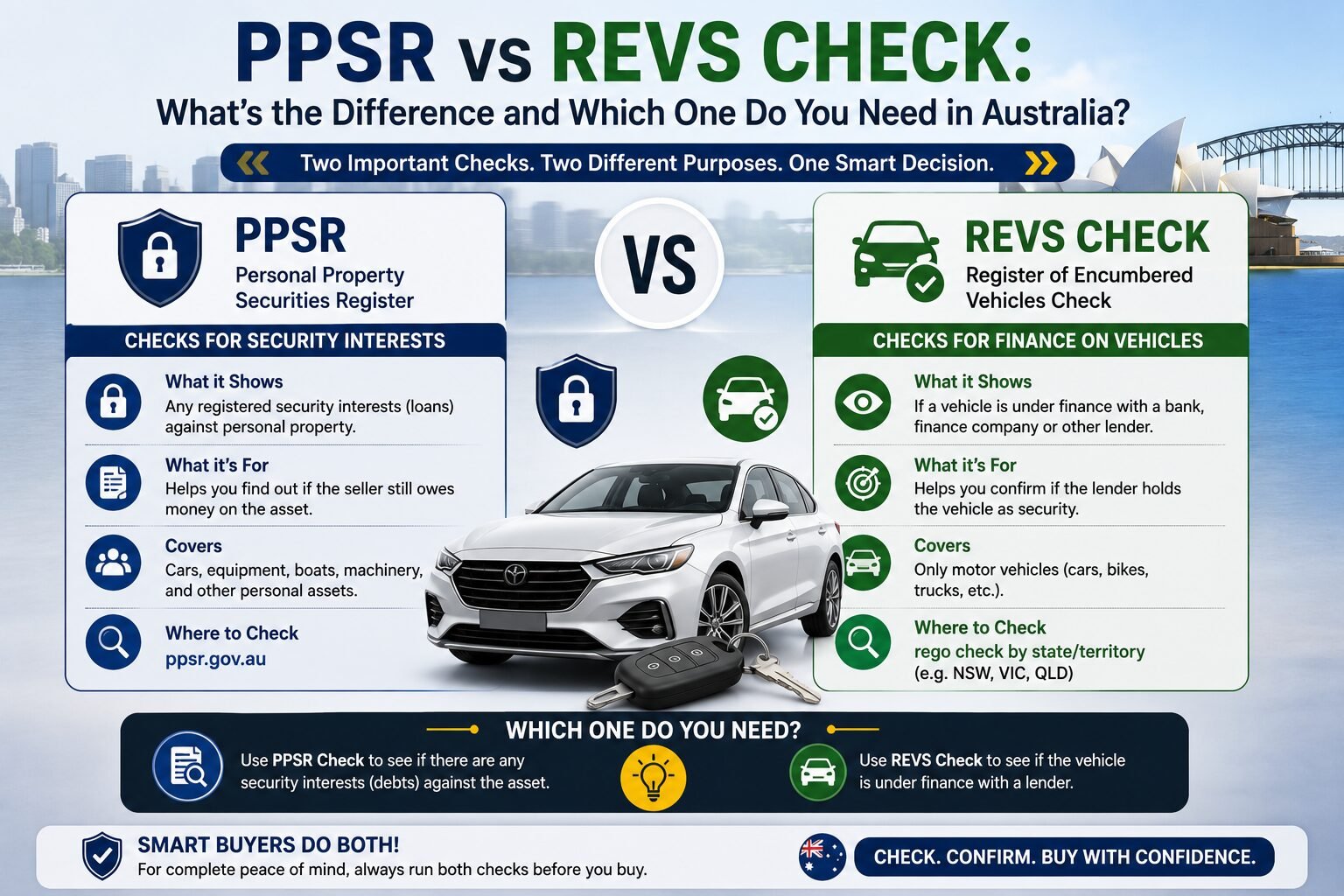
If you’re buying a used car in Australia, you’ve probably come across the terms PPSR check and REVS check. Many Australians especially those who bought vehicles before 2012 still refer to vehicle finance checks as a REVS check, while newer buyers are more familiar with the Personal Property Securities Register (PPSR).
This often leads to confusion. Are PPSR and REVS the same thing? Can you still get a REVS check? Which one should you use before buying a used car?
The short answer is that the PPSR replaced the REVS system in 2012, making the PPSR the official national register for recording security interests in personal property across Australia. Today, if someone says they need a REVS check, they almost always mean they need a PPSR check.
This guide explains the differences between PPSR and REVS, how the systems evolved, and why a PPSR check is now the recommended option for anyone buying a used vehicle in Australia.
What Is a REVS Check?
REVS stands for Register of Encumbered Vehicles.
Before 2012, several Australian states and territories operated their own REVS systems. These registers allowed buyers to check whether a vehicle had money owing or was subject to a financial interest before completing a purchase.
Because each state had its own register, the process was fragmented and could vary depending on where the vehicle was located.
A REVS check was commonly used when buying:
- Used cars
- Motorcycles
- Trucks
- Caravans
- Commercial vehicles
Its main purpose was to help buyers identify whether another party had a financial claim over the vehicle.
What Is the PPSR?
The Personal Property Securities Register (PPSR) is Australia’s national online register for recording security interests in personal property.
Introduced under the Personal Property Securities Act 2009 (PPSA), the PPSR replaced multiple state and territory registers including REVS with a single national system.
Unlike the old REVS system, the PPSR is not limited to vehicles. It records security interests in many types of personal property, including:
- Cars
- Motorcycles
- Trucks
- Boats
- Caravans
- Trailers
- Farm machinery
- Construction equipment
- Business equipment
- Aircraft
- Livestock
- Inventory
- Intellectual property
Today, the PPSR is the official register used across all Australian states and territories.
Why Was REVS Replaced?
The Australian Government introduced the PPSR to simplify secured transactions and create a consistent national system.
Before the PPSR:
- Each state operated different vehicle registers.
- Registration rules varied.
- Buyers often had to use different systems.
- Businesses faced additional administrative complexity.
The PPSR replaced these separate systems with one national register, making searches more consistent and efficient.
When Did PPSR Replace REVS?
The PPSR officially replaced REVS on 30 January 2012.
From that date onward, REVS checks were phased out, and the PPSR became the official system for recording security interests in personal property.
Although the REVS name is still widely recognised, particularly among long-time motorists and dealerships, the PPSR is now the standard system used throughout Australia.
PPSR vs REVS: Quick Comparison
| Feature | PPSR | REVS |
| Full Name | Personal Property Securities Register | Register of Encumbered Vehicles |
| Status | Current national system | Historical system (replaced) |
| Introduced | 2012 | Prior to 2012 |
| Coverage | Australia-wide | State-based |
| Covers Vehicles | ✔ Yes | ✔ Yes |
| Covers Business Equipment | ✔ Yes | ✘ No |
| Covers Machinery | ✔ Yes | Limited |
| Covers Boats & Caravans | ✔ Yes | Limited |
| Security Interests | ✔ Yes | ✔ Yes |
| Official Register Today | ✔ Yes | ✘ No |
The table shows why the PPSR is considered a more comprehensive and modern system.
The Biggest Difference Between PPSR and REVS
The most significant difference is scope.
A REVS check focused primarily on motor vehicles.
The PPSR covers a much broader range of personal property.
For example, businesses can register security interests over:
- Manufacturing equipment
- Farm machinery
- Commercial vehicles
- Construction equipment
- Office equipment
- Inventory
- Livestock
- Intellectual property
This broader coverage makes the PPSR useful for both consumers and businesses.
Is a REVS Check Still Available?
No.
The original REVS systems no longer operate as Australia’s official registers.
If you search online for a REVS check today, you will generally be directed to services that perform a PPSR search instead.
In practice, “REVS check” has become an informal term that many Australians still use when referring to a PPSR check.
Why Do People Still Say “REVS Check”?
Many Australians purchased vehicles before 2012 and became familiar with the REVS system.
As a result, the term “REVS check” continues to be used in everyday conversation, even though the official system has changed.
It is similar to how some older brand names remain part of common language long after they have been replaced.
What Information Does a PPSR Check Provide?
A PPSR search provides information about registered security interests associated with the searched property.
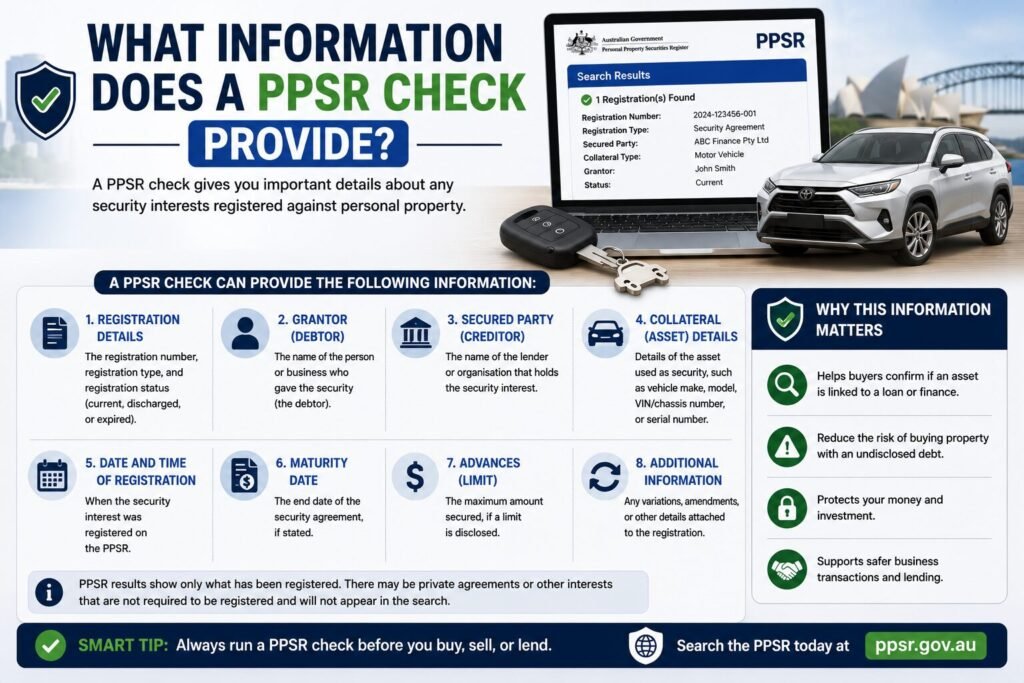
Depending on the search and asset, a PPSR certificate may include:
- Search details
- Registration status
- Security interests
- Registration dates
- Collateral information
- Registration duration
- Secured party information
Understanding these details can help buyers identify whether further investigation is needed before completing a purchase.
Does a PPSR Check Replace a Vehicle Inspection?
No.
A PPSR search focuses on registered security interests, not the physical condition of the vehicle.
It generally does not tell you about:
- Mechanical condition
- Accident damage
- Flood damage
- Engine problems
- Service history
- Odometer accuracy
- Tyre condition
- Roadworthiness
For the best protection, combine a PPSR search with:
- An independent mechanical inspection
- VIN verification
- Service records
- Registration checks
- Ownership documentation
Benefits of Using a PPSR Check
Compared with the old REVS system, the PPSR offers several advantages.
National Coverage
One system serves all Australian states and territories.
Broader Asset Coverage
The PPSR covers much more than vehicles.
Improved Transparency
Buyers and businesses can review registered security interests before completing transactions.
Supports Commercial Transactions
The register is widely used in lending, leasing, and business finance.
Consistent National Rules
The PPSR provides a uniform legal framework throughout Australia.
When Should You Perform a PPSR Check?
A PPSR search is recommended before purchasing:
- Used cars
- SUVs
- Motorcycles
- Trucks
- Caravans
- Boats
- Trailers
- Farm machinery
- Construction equipment
- Commercial equipment
It is also commonly used by businesses before acquiring valuable assets.
What If Someone Tells You to Get a REVS Check?
In most cases, they are referring to a PPSR search.
If a dealership, mechanic, friend, or seller recommends a REVS check, the modern equivalent is a PPSR check.
You do not need to look for a separate REVS system.
Common Myths About PPSR and REVS
“REVS and PPSR are completely different.”
Not really.
The PPSR replaced the REVS system and now performs its role within a broader national framework.
“You still need a REVS check.”
No.
Today, a PPSR search is the appropriate check for identifying registered security interests.
“PPSR only covers vehicles.”
Incorrect.
The PPSR covers many different types of personal property, including machinery, equipment, inventory, and other commercial assets.
“A PPSR search proves ownership.”
No.
The PPSR records security interests it does not determine legal ownership.
Ownership should be confirmed separately through the relevant documentation.
Which One Should You Use?
For anyone buying a used vehicle in Australia today, the answer is straightforward.
You should use a PPSR check.
The PPSR is:
- Australia’s official national register
- Widely recognised by lenders and businesses
- Applicable across every state and territory
- Suitable for both consumers and commercial users
Although many people still use the phrase “REVS check,” the PPSR is the current system that has replaced it.
Frequently Asked Questions
Is REVS the same as PPSR?
Not exactly. REVS was the former state-based system used before 2012, while the PPSR is the current national register. Today, when people mention a REVS check, they usually mean a PPSR check.
Can I still get an official REVS check?
No. The original REVS registers have been replaced by the PPSR.
Why do dealerships still say REVS check?
The term remains widely recognised among Australians who purchased vehicles before the PPSR was introduced. It is often used informally, even though the official system is now the PPSR.
Is a PPSR search required before buying a used car?
While not legally required in most situations, performing a PPSR search is widely recommended as part of your due diligence before purchasing a used vehicle.
Does a PPSR check show ownership?
No. A PPSR certificate records registered security interests but does not confirm legal ownership of the property.
Conclusion
Although the term REVS check is still commonly used in Australia, the Personal Property Securities Register (PPSR) has been the official national system since 2012. The PPSR replaced the old state-based REVS registers with a single, comprehensive platform that records security interests in vehicles and many other types of personal property.
For today’s buyers, businesses, and lenders, a PPSR check is the modern and reliable way to review registered security interests before purchasing a used vehicle or valuable asset. Understanding the relationship between PPSR and REVS helps eliminate confusion and ensures you’re using the correct system when carrying out due diligence before your next purchase.